

Download this report as PDF (5 mb)
Foreword
Three years into Ferdinand Marcos Jr.’s presidency, it has taken on a “Squid Game”-like atmosphere as it reaches its midpoint. Every Filipino seems trapped in a cruel children’s game—forced to jump over thorns just to survive—but with the odds stacked against them, losing feels inevitable. The Filipino people persistently struggle to exercise their human rights as the government continues its downward trajectory, deepening the economic crisis, fostering a culture of impunity, and exhibiting continuous neglect of its human rights obligations. Engagements with community partners, families of human rights violation victims, sectoral representatives, civil society groups, and human rights advocates reveal worsening conditions, reinforcing widespread concerns about government failure.
Instead of addressing the urgent needs of the majority, the administration lacks a clear and sustainable socioeconomic vision. Prices of basic goods and services remain high and keep rising, education is neglected, and healthcare security is in jeopardy—clear indicators of the government’s failure to fulfill its promise of a better society.
This report unveils the harsh socioeconomic realities on the ground and critically examines policies that continue to harm rather than uplift the people. Filipinos are tired of false hope and empty promises—especially as the midterm elections draw near. This is a wake-up call for every Filipino to choose wisely and support candidates who will stand with them and fight for All Human Rights for All.
Part 1. Jumping Over Barriers: The Fight for Economic, Social, and Cultural Rights
Resilience has long been a key part of Filipino culture, enabling the country to withstand both Western and Eastern colonizers in the past. This “Pinoy Perseverance” has made it difficult for people to recognize that their economic, social, and cultural rights are systematically abused and weaponized. Conditioned to accept hardships as an inevitable part of life, Filipinos inadvertently reinforce a cycle of exploitation. This deeply ingrained mindset is now manipulated by those in power, framing survival amidst suffering as a virtue rather than a consequence of poor governance.
The price of survival
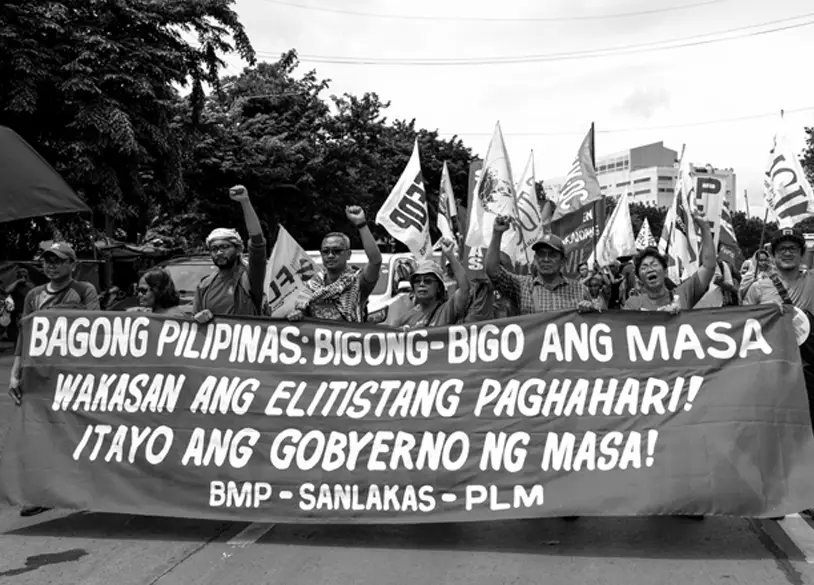
The mounting toll of the Marcos Jr. Administration’s negligence of the people’s welfare, along with the failed promise of Bagong Pilipinas, is all the more apparent. Three years into his presidency, the effects of depressed wages, the workers’ entrenchment in informal labor, and an economic growth best described as job-losing further plunge Filipinos deeper into poverty.
As our partner families revealed, bouncing back from the economic downturn of the previous Duterte administration has only become more difficult under Marcos Jr.’s leadership. His failure to keep his campaign promises has resulted in ever increasing hardships for them as they juggle multiple jobs just to make ends meet.
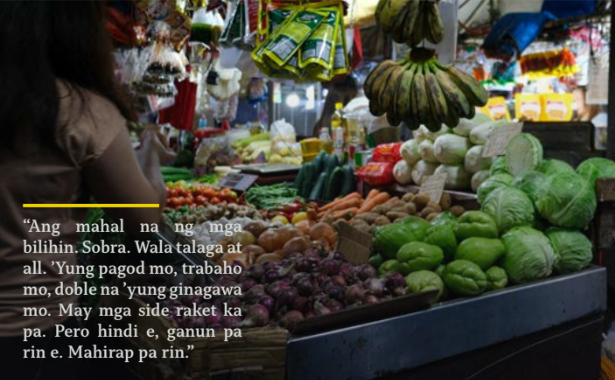
“Ang mahal na ng mga bilihin. Sobra. Wala talaga at all. ’Yung pagod mo, trabaho mo, doble na ’yung ginagawa mo. May mga The price of survival side raket ka pa. Pero hindi e, ganun pa rin e. Mahirap pa rin. [Prices of goods are so high now. It’s too much. There’s really nothing left at all. No matter how hard you work, no matter how much effort you put in—even if you take on extra side
jobs—it’s still the same. It’s still hard.]”
This narrative, consistent across PhilRights’ partner communities, nuances the uptick in employment touted by the state. The Labor Force Survey claims that the country’s employment rate in November 2024 was estimated at 96.8%— a 0.4% increase from the same period last year. The unemployment rate was also pegged lower at 3.2%, down from last year’s 3.6%. However, these figures do not necessarily translate to better employment conditions.
Of the 49.54 million employed Filipinos, 5.35 million— who worked an average of almost 41 hours per week (an increase from last year’s 40.2 hours)— still seek longer hours or
additional jobs just to survive. The current minimum wage averages at Php465, a mere fraction of the Php1,224 average family living wage for a family of five needed to live decently. For many years, families have been trapped in this endless cycle of poverty.
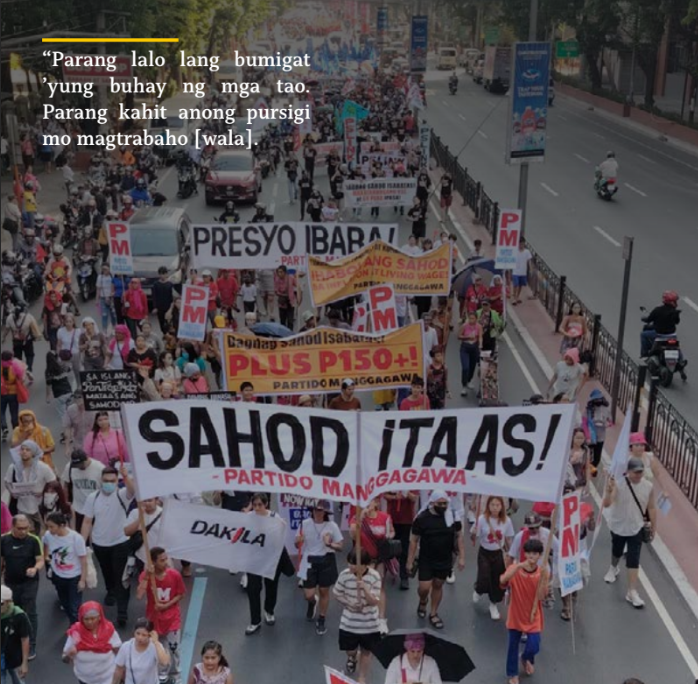
“Parang lalo lang bumigat ’yung buhay ng mga tao. Parang kahit anong pursigi mo magtrabaho [wala]. [It feels like life has only gotten harder for people. No matter how hard you try, no matter how much you work, it still feels like nothing.]”
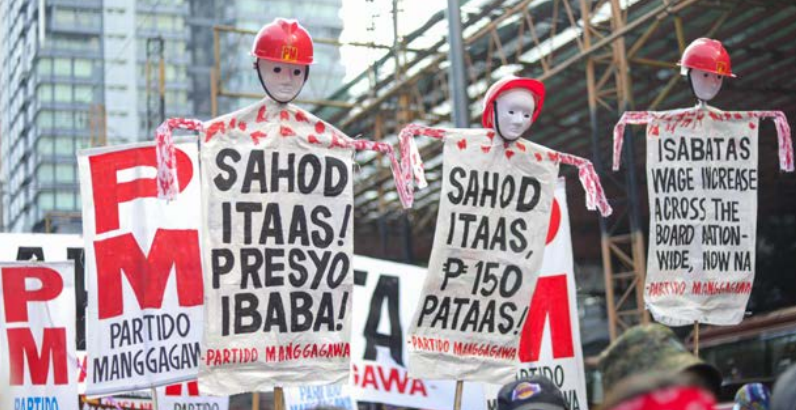
Despite claims of economic recovery, this growth in employment has been accompanied by widespread informality, as job creation is concentrated in low paying and insecure sectors such as domestic work (househelps, drivers, gardeners, etc.) or wholesale and retail trade. Moreover, those opting to be self-employed or gig economy workers have surged to 13.7 million, up from 12.4 million in 2023. This shift towards informality is fueled by the deteriorating working conditions and depressed wages in the formal sector, forcing more towards informal work. Further exacerbating this surge in informality is the 35-year stagnation in across-the-board wage increases, with at least nine bills currently pending in congress seeking hikes from Php150 to Php750. With the continuous contraction of the productive sectors of agriculture, forestry, and fisheries, and stagnating wages, decent work in the Philippines remains elusive for the vast majority of Filipinos.
These inhumane working conditions continue to entice Filipinos to work abroad, even in the face of rampant exploitative and illegal recruitment. The Department of Migrant workers claims to have curbed illegal recruitment twice as fast as it did in 2023—yet they admit that putting a stop to the problem at the grassroots level remains a challenge due to local officials being complicit and with workers’ desperation leading them to be vulnerable. Domestic workers, who comprise the majority of the Overseas Filipino Workers (OFWs), bear the brunt of such questionable recruitment
schemes. Those employed outside of the already-inefficient government monitoring system for OFW welfare end up being exploited—or worse, dead. Similarly, Filipino seafarers, even with the passage of the Magna Carta of Filipino Seafarers, are still driven to exploitation due to promises of providing more for their families. Amid calls to ratify the International Labor Organization’s (ILO) Work in Fishing Convention (No. 188), seafarers who have suffered human rights violations hope for a safer, more dignified life at sea.
Jeepney operators remain troubled as the Public Utility Vehicle Modernization Program (PUVMP) continues to move forward despite the fierce opposition. As testament to this, widespread support has led to the deadline for consolidation being expanded twice in 2024. According to the Land Transportation Franchising and Regulatory Board (LTFRB), nationwide consolidation is now at 73.96%, apparently proving the program’s effectiveness. But according to the operators, the PUVMP remains to be anti- poor, displacing local industries and workers in jeepney manufacturing and about 38,000 jeepney drivers and their families. Operators and drivers are protesting the consolidation, as it allows the monopolization of public transportation by corporations and makes mere entry into a cooperative prohibitive, with some demanding Php30,000 for an individual driver to enter. The program disenfranchises and pushes drivers deeper into poverty, their jeepneys are placed under a cooperative’s ownership upon entry. To cover debt repayment and living costs they would need to earn up to Php7000 per day. This financial strain could drive base fares to increase as much as Php40, causing real wages to further plummet.
All the while, democratic spaces for asserting labor rights continue to shrink, with red-tagging of progressive groups and unions being one of the most sinister threats. This has resulted in declining union membership across the country, as those tagged as communists fall victim to harassment, violence, arbitrary arrests, and even abduction perpetrated by the National Task Force to End Local Communist Armed Conflict (NTF-ELCAC). To this end, the International Trade Union Confederation (ITUC) has given the Philippines a score of 5, meaning “no guarantee of rights,” in its 2024 Global Rights Index and has included the Philippines in the top 10 worst countries for workers.
Fed but malnourished
As prices steadily rise amidst stagnating wages, our partner families report heightened poverty. This reality is backed by the Social Weather Stations, as its latest findings reveal that Filipinos’ self-rated poverty has reached its highest level in 21 years. According to the poll, 63% of families perceive themselves as poor, compared to 59% last year. This translates to 17.4 million self-rated poor families, an increase from last year’s 16.3 million. Moreover, 10.2% of the 63% who self-identified as poor are newly poor families. This means 2.8 million families who were not poor just 1-4 years ago but now identify as poor.
Latest figures from the Philippine Statistics Authority, however, contrast these findings as official figures claim that the country’s poverty incidence has gone down by 2.3%. The rate has dropped from 13.2% in 2021 to 10.9% in 2023, translating to just 2.99 million families who are living below the poverty threshold. This narrative extends to the National Economic and Development Authority’s (NEDA) infamous Php64 food poor threshold which classifies only those who spend Php64 pesos and below a day for three meals are considered food poor.

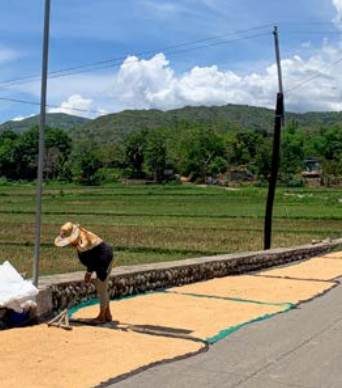
The agricultural sector continues to see consistent declines in output with 2024 being no exception. The sector contracted by 2.2% due to drought, disasters, and animal diseases, and has partially resulted in a record high of 4.68 million metric tons of rice being imported by the Philippines in 2024. However, it must be made clear that the Philippines being the world’s largest importer of rice is not merely due to droughts and disasters but is also a result of the government’s institutionalization of rice import dependency. Under the Rice Liberalization Act, the Philippines saw rice import dependency swell from 13.8% in 2018 to 23% in 2022, and retail prices of regular milled rice from Php43 in 2018 to Php46 in May 2024.
The Alyansa ng Manggagawa sa Agrikultura (AMA) primarily attributes the regressive state of agriculture in the Philippines to various factors such as unregulated traders and loan sharks, import dependence, insufficient government subsidies, and most of all, usurious land rent. AMA pegs land rent at around Php 55,000 per hectare. With such rates, farmers expect to take home only Php 10,000 in earnings for three to four months’ worth of harvest. According to AMA, this is further aggravated by the monopolization of land by corporations and further entrenches peasants in landlessness.
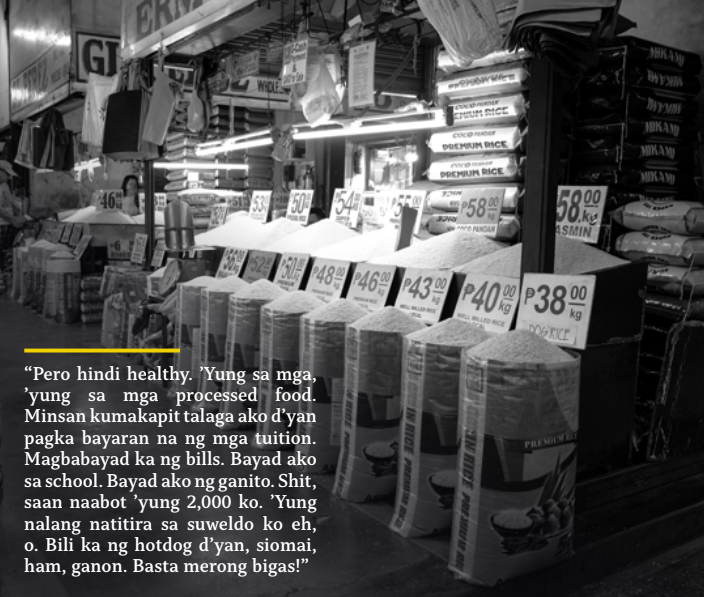
To this end, PhilRights’ partner families have revealed some considerable changes in their diet and nutrition due to food inflation. Due to rising prices, some lament their increasing dependency on relatively cheaper processed food to manage their daily food expenses. “Pero hindi healthy. ’Yung sa mga, ’yung sa mga processed food. Minsan kumakapit talaga ako d’yan pagka bayaran na ng mga tuition. Magbabayad ka ng bills. Bayad ako sa school. Bayad ako ng ganito. S**t, saan naabot ’yung 2,000 ko. ’Yung nalang natitira sa suweldo ko eh, o. Bili ka ng hotdog d’yan, siomai, ham, ganon. Basta merong bigas! [But it’s not healthy. These, these processed foods. Sometimes, I really have to rely on it, especially when it’s time to pay tuition. You have to pay bills, school fees, and other expenses. Damn, where does my Php2,000 even go? That’s all I have left from my salary. So, you just buy hotdogs, siomai, ham—whatever. As long as there’s rice!]”
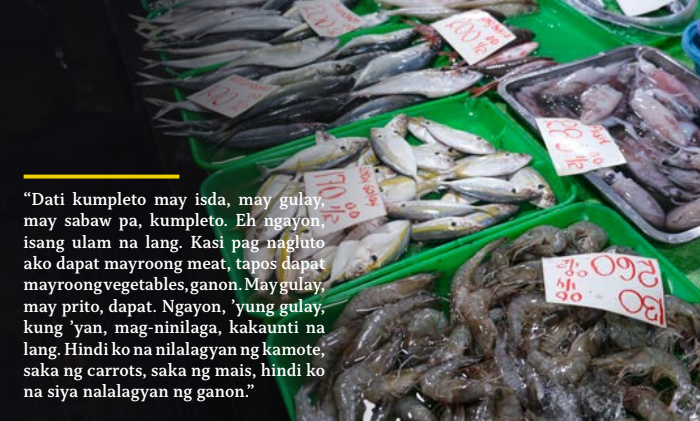
Other partner families feel the effect of food inflation to a greater extent, with a significant reduction in quantity and quality of the food they eat, especially in the past year. “Dati kumpleto may isda, may gulay, may sabaw pa, kumpleto. Eh ngayon, isang ulam na lang. Kasi pag nagluto ako dapat mayroong meat, tapos dapat mayroong vegetables, ganon. May gulay, may prito, dapat. Ngayon, ’yung gulay, kung ’yan, mag-ninilaga, kakaunti na lang. Hindi ko na nilalagyan ng kamote, saka ng carrots, saka ng mais, hindi ko na siya nalalagyan ng ganon. [Before, meals were complete—there was fish, vegetables, even soup. Everything was complete. But now, it’s just one dish. When I cook, there should be meat, and there should be vegetables. There should be veggies and something fried. But now, when I make a stew, I use fewer ingredients. I don’t add sweet potatoes, carrots, or corn anymore. I just can’t afford to include them.]”
The Marcos Jr. administration’s strategy of easing protectionist policies to increase food supply and decrease prices only leads to increasing losses for local producers in the long run. The Comprehensive Tariff Program, which reduces tariffs on corn, pork, and mechanically deboned meat, and most notably, rice from 35% to 15% is merely a temporary solution in slowing down inflation. Reduced tariffs will only lead to foreign suppliers increasing their prices. The country’s downwards spiral towards liberalization will only push farmers towards poverty and the country towards greater food insecurity. With a fraudulent agrarian reform program, which enables the illegal land use conversion and land grabbing of irrigable lands to the susceptibility of Philippine produce to floods in supply by imports, Filipinos will likely continue to bear the brunt of food insecurity for the foreseeable future.
Unfit, unseen, uncared for
In an event in Nueva Ecija, Marcos announced the “Zero Billing Program,” his birthday blowout to the country. The program, according to the statement released by the Presidential Communications Office (PCO), reflects the administration’s dedication to ensuring that healthcare is more accessible to the people. On the 13th of September the day of the implementation, the program shall cover all hospital bills, drugs, medicines, chemotherapy, dental services, dialysis, implants, laboratory and diagnostic procedures, and therapy and rehabilitative services with a funding allocation of PhP328 million.

To the president, this is a manifestation to his claim that healthcare is the administration’s number one priority. In a statement released through one of his vlogs, he vowed to ensure accessibility, adding that he is strongly committed to prioritizing the country’s healthcare system.
However, situations on the ground reflect otherwise. The “Zero Billing Program” is only a temporary dressing to a rotting wound that is the Philippine healthcare system slowly consuming Filipinos alive.
In 2024, there is a resurgence of recurrent diseases in the country that have previously shown significant decline in the past decade but have since increased again, as the pandemic exposed the vulnerabilities of the healthcare system. Notably, HIV cases have been on the rise with the Philippines as the fastest growing epidemic in the Pacific region having 418% increase daily.
In 2023, the total number of people living with HIV (PLHIV) was recorded at 189,900. If left unattended, it could reach around half a million in seven years, yet it is continuously managed with reactive measures. According to reports, one in three PLHIV is diagnosed at a late stage with only 13% of the key populations aware of preventative measures such as the pre-exposure prophylaxis and only 60% are aware that there are free HIV testing services. According to the UNAIDS Philippines, it is estimated that there are around 40% of PLHIV that remain undiagnosed.
In 2024, there is also an observable decline in vaccine compliance that can be related to decreasing supplies. Outbreaks of infectious diseases such as pertussis and measles in the early to mid of 2024 were recorded in parts of Luzon and Visayas, and in the Bangsamoro region, respectively. Meanwhile, polio is at a high risk in 70% of the provinces and cities in the country.
These vaccine preventable diseases are seen provided with varying levels of support from local governments. In a report from UNICEF, health workers are faced with refusals and deferrals due to misconceptions and vaccine fatigue.
In a report released by the Philippine Statistics Authority, for the year 2024, ischemic heart diseases and neoplasm were the two leading causes of death in the country as of August 2024. Both diseases require regular check-ups for monitoring and intervention. This could be addressed by a robust healthcare system, especially under the provisions of the Universal Healthcare Act. Unfortunately, four years after the passing of the law, it is still stuck in a mere piloting phase. Capacities of local barangay health centers that could serve as the frontline in preventative health interventions have further dwindled both in supplies and manpower, says the Medical Action Group (MAG).
In partner communities, many neglect their ailments, which some may interpret as poor health seeking behavior. However, for a senior citizen in Navotas City, the cost of the laboratory expenses to a senior may as well already be a death sentence.
“Mahirap kasi lagi ka magpa-laboratory. Nalalaman mo lang sakit mo, lalo ka lang manghihina. Ayan kapag nalaman mo, iisipin mo lang, hindi ba? [It’s hard because you always have to get lab tests. The moment you find out about your illness, you just feel even weaker. Once you know, you can’t help but think about it, right?]”
As of August 2024, 44.4% of the total Current Health Expenditure (CHE) is coming from household out-of-pocket payments. Despite the many promises of ayuda and the slow implementation of the UHC, medical costs are shouldered by individuals, with only 42.6% coming from government schemes and compulsory contributions. Out-of-pocket payments for many Filipinos can be so burdensome that they create significant barriers to accessing necessary medical care.
From a resident of Antipolo City, it is still their primary responsibility to access medical services, “Katulad ko po, nagkaroon po ako ng emergency, nadala ako sa ospital. Bigla ako nagkasakit. Eh, siyempre kung wala akong extrang pera, di kami makaka [pag-pagamot]… [Like me, I had an emergency and was rushed to the hospital. I suddenly got sick. But of course, if I don’t have extra money, we won’t be able to afford treatment…]”
The Universal Healthcare Act mandates that incomes generated by the Philippine Health Insurance Corporation (PhilHealth) are protected from misuse, and that these funds should be allocated to improve services, expand coverage, and support implementation of the UHC Act. The demand of the Department of Finance (DOF) to transfer the PhP89.90 billion is not only controversial but is also a direct hit on the rights of many Filipinos to healthcare.
In a statement by Sen. Hontiveros, the length of the queue at various government agencies and even lawmakers’ offices should be enough proof that the available programs are far from the achievement of universal healthcare. According to her, no PhilHealth fund shall accrue into the general fund of the national government. Despite that, DOF under Secretary Ralph Recto pushed the transfer of the funds, emphasizing its legality under the General Appropriations Act of 2024.
The implementation of public health interventions, whatever is available, remains partial—leaving out mental health to be inaccessible, that only the privileged few could care to see as integral to their overall well being. In December 2024, President Marcos Jr. signed the Basic Education Mental Health and Well-Being Promotion Act into law. The law aims to institutionalize comprehensive mental health initiatives in the basic education institutions to foster awareness, provide preventative measures, and support the well-being of students. While the law proposes a great promise its success is yet to be determined.
The Mental Health Act of 2018 (RA 11036) mandates community-based care, evidence-based care, accessibility, all key components to attaining holistic care for many Filipinos. However, much like the UHC, despite the years that have passed, the law seems to be still at its infancy.
_____________________
“Katulad ko po, nagkaroon po ako ng emergency, nadala
ako sa ospital. Bigla ako nagkasakit. Eh, siyempre kung
wala akong extrang pera, di kami makaka [pag-pagamot]…”_____________________
Community-based care, that is only available to select local government units, particularly for individuals with drug dependence, can be considered as a coercive method of submission of individuals. In a report by Amnesty International, cases of arbitrary detention in relation to the violation of the Comprehensive Dangerous Drugs Act of 2002 facilitates the “punishment” in
government-run and court-recommended facilities undergoing mandatory drug testing that individuals’ shoulder out-of-pocket, and forced abstinence. A total violation of the essence of rehabilitation and the individuals’ reintegration to society.
Moreso, the criminalization of drug use and the ill-implementation of the war on drugs that have continued into the Marcos Jr . administration, have only exacerbated the underlying conditions of the issue, to which drugs should primarily be resolved with the public health intervention perspective.
The overall healthcare system of the country is still built upon centuries-old and outdated principles of residual welfare and relief, better known as ayuda. Structures to address inefficiency, inaccessibility, lack of resources, inadequate coverage and other underlying factors are neither prioritized nor resolved which truly raises the questions of sincerity on the universality of healthcare in the Philippines.
Weaponized education
It has been ingrained in many people’s minds that the only way to escape poverty is through education—a tool meant to uplift individuals and break the cycle of deprivation. However, in the current state of the country’s educational system, this promise rings hollow. The poor remain poor, as access to quality education is increasingly becoming a privilege rather than a right, with opportunities deliberately withheld from many Filipinos.
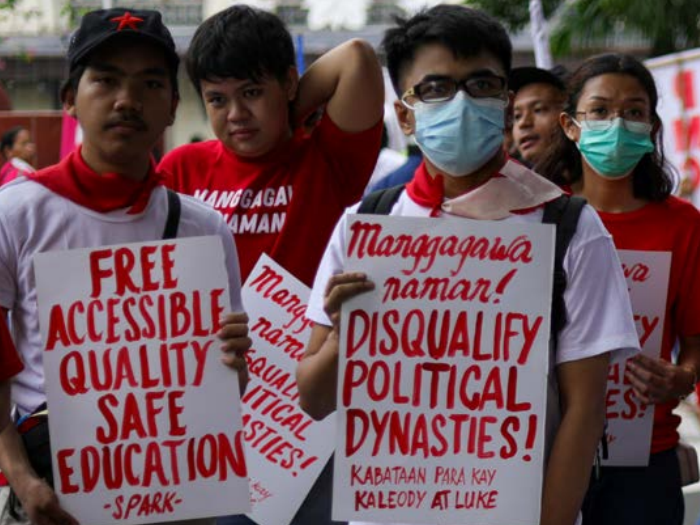
At the heart of the worsening learning crisis, Vice President Sara Duterte’s tenure as Secretary of the Department of Education was marred by a series of controversies, including allegations of corruption, misuse of confidential funds, and the red-tagging of public high schools. The alleged misallocation of confidential and intelligence funds drew widespread criticism from lawmakers, educators, and advocacy groups. Questions were raised about the necessity and transparency of such funds in an agency primarily responsible for education rather than national security. Critics argued that these funds could have been better allocated to address urgent concerns such as classroom shortages, teacher salaries, and learning materials.
Duterte also faced backlash for her role in the red-tagging of public high schools and educators. This raised concerns about academic freedom and the safety of those targeted, as red-tagging has historically led to harassment and violence against activists and educators. These controversies further eroded public trust in the Department of Education’s leadership, reinforcing concerns about governance, accountability, and the prioritization of political interests over genuine educational reform.
The Second Congressional Commission on Education (EDCOM II), tasked with conducting a comprehensive national assessment of the Philippine education system, released its report in early January 2024. The report highlighted various concerns, including systemic internal issues within the Department of Education, the state’s continued neglect of adequate budget allocation for education, the lack of accountability among its leaders for systemic failures, and the implementation of vague programs.
Principals, school heads, officers-in-charge, and teachers are burdened with the responsibility of adapting to current conditions, further contributing to the systemic failures of an already broken system—one that can hardly be considered fully functional. As a result, teaching personnel are overwhelmed with unnecessary workloads, leading to a mismatch between their skills and expertise and what they can effectively deliver to students.
Students, on the other hand, bear an even greater burden, particularly those from lower economic brackets. The persistent lack of essential resources—such as books, basic school supplies, and other educational and personal necessities—remains a pressing issue. This challenge is largely rooted in the lack of better income opportunities for their parents, making it difficult to support their children’s education.
The basic education enrollment-to-dropout ratio has shown slight improvement. According to the report, “Despite the slight dip in SY 2020–2021 at the height of the COVID-19 pandemic, enrollment rates have returned to previous levels, with 27,794,282 students enrolled in the current school year. Even enrollment in private schools, which declined by almost 800,000 during the same period, has steadily increased.” However, this positive trend does not extend to higher education, where the college attrition rate remains concerning. During a Senate hearing on October 1, 2024, regarding the proposed 2025 budget for the Commission on Higher Education (CHED), Senator Joel Villanueva highlighted the issue, noting that the attrition rate in higher education stood at 40.6% for batch 2021 and 39.3% for batch 2022.
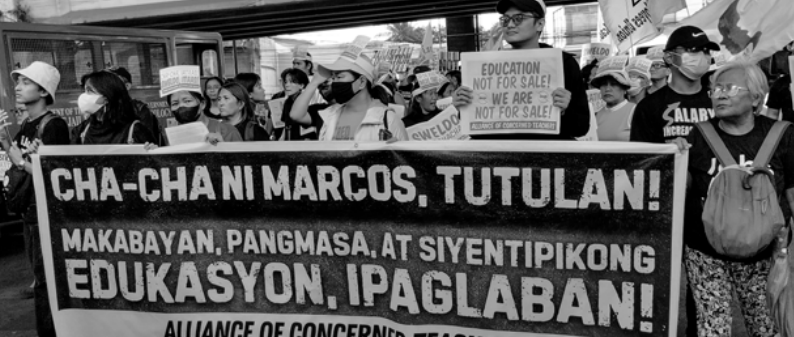
Housing, a luxury
Under Republic Act No. 7279, or the Urban Development and Housing Act, the State must “uplift the conditions of the underprivileged and homeless citizens in urban areas and in resettlement areas by making available to them decent housing at affordable cost, basic services, and employment opportunities.” However, informal settlements in Manila and Quezon City have undergone demolitions without prior relocation of settlers nor provisions for aid or support. Discussions with partner communities highlight the government’s failures in upholding the law. Families report
that despite paying their rent, they still receive receipts indicating non-payment. They mentioned that these irregularities started during the leadership changes at the National Housing Authority (NHA). With the fear of losing their homes, they still paid their dues, leading to incurred debts. Further, they expressed dilemmas on which they have to prioritize first– keeping mouths fed or the roof over their heads.
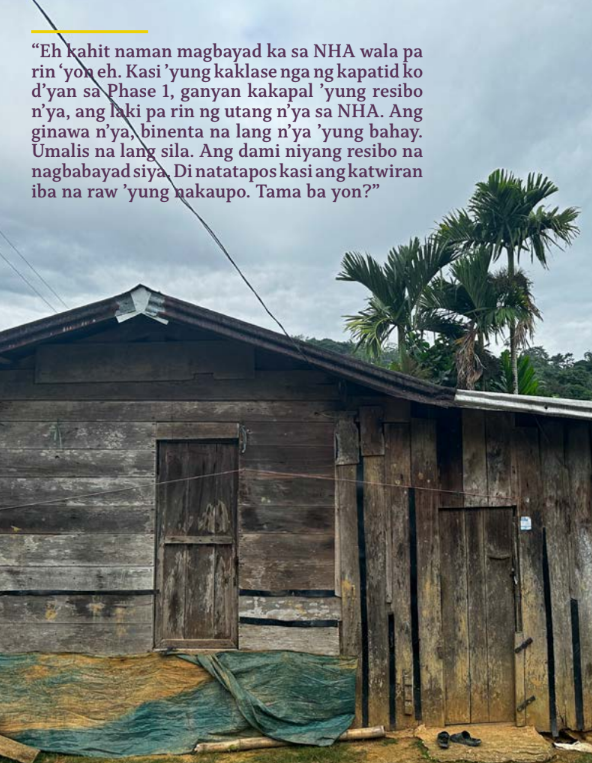
“Eh kahit naman magbayad ka sa NHA wala pa rin ‘yon eh. Kasi ’yung kaklase nga ng kapatid ko d’yan sa Phase 1, ganyan kakapal ’yung resibo n’ya, ang laki pa rin ng utang n’ya sa NHA. Ang ginawa n’ya, binenta na lang n’ya ’yung bahay. Umalis na lang sila. Ang dami niyang resibo na nagbabayad siya. Di natatapos kasi ang katwiran iba na raw ’yung nakaupo. Tama ba yon? [Even if you pay the NHA, it still doesn’t make a difference. My sibling’s classmate in Phase 1 had a stack of receipts that thick, yet they still had a huge debt with the NHA. In the end, they just sold the house and left. They had so many receipts proving they were paying, but the debt never seemed to end because, according to them, there’s a new administration in charge. Is that fair?]”
The challenges of the urban poor with housing extend beyond sustaining its cost and circumventing displacement. Utility costs rose throughout the year and by the end of 2024, it was announced that both electricity and water rates will increase once again by 2025. This rising expenses worsens the already substandard living conditions for the urban poor, further straining their efforts to meet their basic needs.
In a Senate hearing, Department of Human Settlements and Urban Development (DHSUD) Secretary Jose Acuzar said, “Magwalis lang sa kalsada ’yan, makakabayad na ng bahay na tinatayo namin.” The Marcos Jr. administration initiated the Pambansang Pabahay Para sa Pilipino (4PH), a housing program that is an extension to the Pantawid Pamilyang Pilipino Program (4Ps), which aims to address poverty incidences of low-income families. Under 4PH, beneficiaries are still obliged to pay Php4,000 per month despite the program’s allocated budget of Php1.5 billion for 2024, of which is tasked to the DHSUD.
Reports from partner communities in Manila state that several 4Ps beneficiaries appear to be able to afford housing. “’Yung iba, meron nga doon, ’yung nakabili ng 2,000,000 – 4,000,000 bahay. Kilala ko ‘yun. Kasi pinapakita niya pong bahay. Pag sinu-swete siya, ’yung bulok-bulok na bahay, nais-stackan ng mga lupa nila. Pero ’yung mga bahay-bahay niya, magaganda na mga nabili niya, hindi niya pinapakita. Tapos 4Ps pa rin siya. [Some people, I know someone who bought a house worth Php2,000,000 to Php4,000,000. I know them because they would show off their house. When they get lucky, their old, run-down house just ends up sitting there on their land. But the nice houses they bought—they don’t show those. And yet, they’re still receiving benefits from the 4Ps program.]” Further, beneficiaries were required to attend activities that involve modules, and if unaccomplished, a certain amount will be decreased to their financial aid. “Parang nag-aaral sila ng ilang page, pati nanay may module. Kapag wala kang ganun, 1,500 ’yung bawas. [It’s like they’re studying a few pages, and even the parents have modules. If you don’t comply, they deduct Php1,500.]” Meanwhile, partner communities in Bulacan reported incidences of patronage politics within the implementation of the program, in that beneficiaries with ties to authorities are more likely to acquire financial aid.
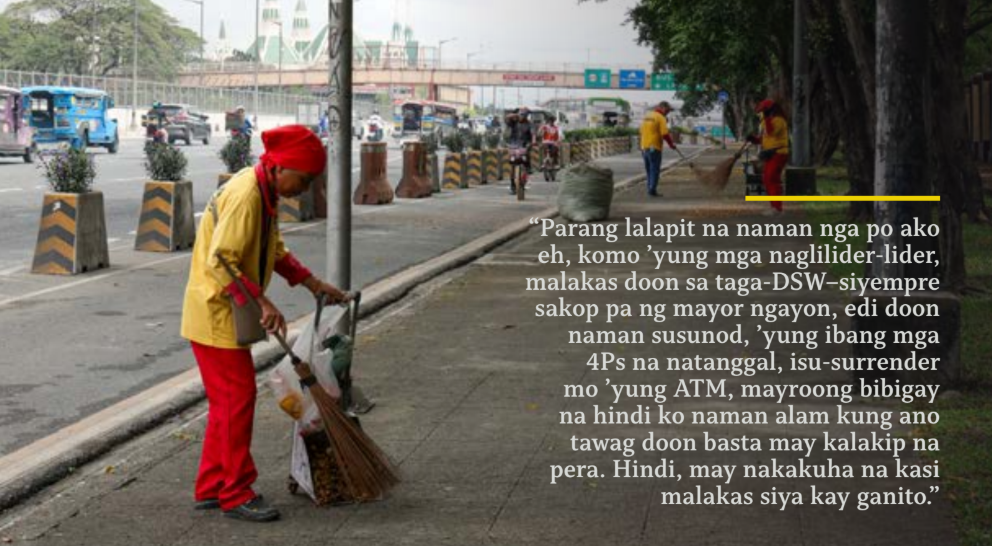
“Parang lalapit na naman nga po ako eh, komo ’yung mga naglilider-lider, malakas doon sa taga-DSW—siyempre sakop pa ng mayor ngayon, edi doon naman susunod, ’yung ibang mga 4Ps na natanggal, isu-surrender mo ’yung ATM, mayroong bibigay na hindi ko naman alam kung ano tawag doon basta may kalakip na pera. Hindi, may nakakuha na kasi malakas siya kay ganito. [It feels like I have to approach them again because those who act like leaders have strong connections with the DSWD—of course, since it’s still under the mayor’s jurisdiction, they follow them. Some 4Ps beneficiaries who got removed have to surrender their ATM cards, and in return, they receive something—I don’t even know what it’s called, but it comes with money. Some people manage to get it just because they have strong connections with certain officials.]”
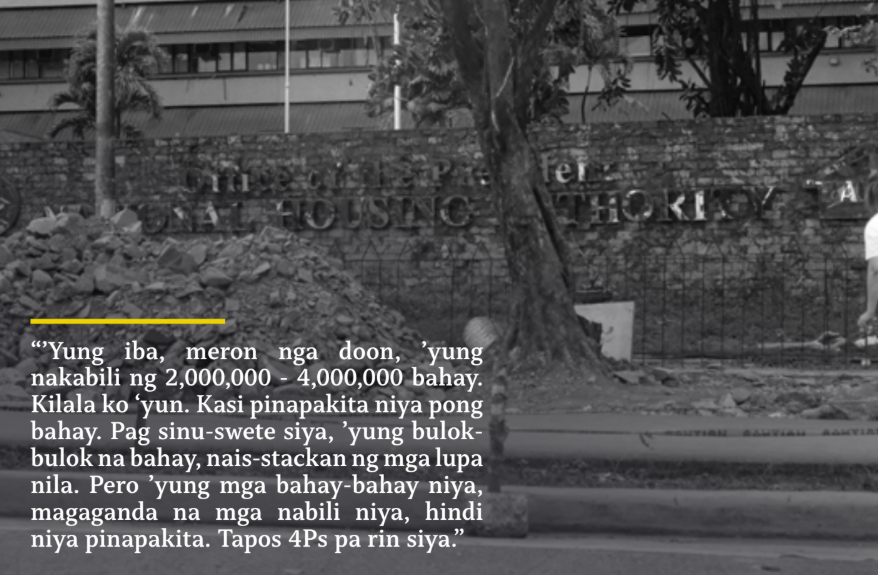
According to the World Population Review, the Philippines ranks 9th in homelessness with 4,500,000 million unhoused individuals for the year 2024. Given the gravity of the homelessness issue, it must be addressed with intersectionality, as maintaining a home constitutes financial upkeep, of which would not be possible without a source of income. This would be more possible if access to quality government services is readily available.
In the Eye of the Storm
The climate crisis continues to escalate, leading to more frequent and intense typhoons. Despite decades of experiencing multiple typhoons annually, the Philippines still lacks sufficient disaster preparedness and response mechanisms. In 2024, the government allocated Php22.736 billion for calamity funds, yet lives were lost, and crops and lands were devastated by destructive typhoons like Carina and Pepito. Filipinos continue to suffer the consequences of inadequate disaster resilience.
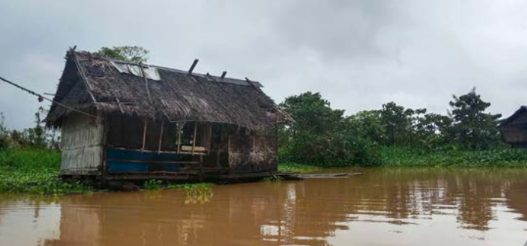
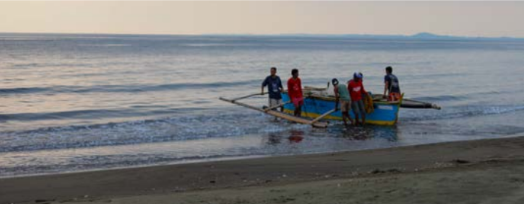
There are currently 187 proposed and ongoing reclamation projects. In an effort to preserve their human, land, and cultural rights, indigenous peoples are met with militarization and displacement. The Manobo-Pulangiyon’s ancestral lands have been illegally taken from them by the Kianteg Development Corporation (KDC), and members of the indigenous group are either red-tagged or shot for reclaiming their lands. Further, they are enduring life-threatening risks amidst the century-long struggle for their rights; being displaced to the side of the road have led to deprivation of access to food and water, as well as inability to practice their cultures. In the same vein, the Kaliwa Dam Project displaced the Dumagat-Remontados indigenous group, embargoing their land and cultural rights. The project has also heightened the risk of flooding, negatively affecting local and indigenous communities. With the Sierra Madre mountain range majorly deforested, the country’s biodiversity and the nearby communities’ lives are threatened.
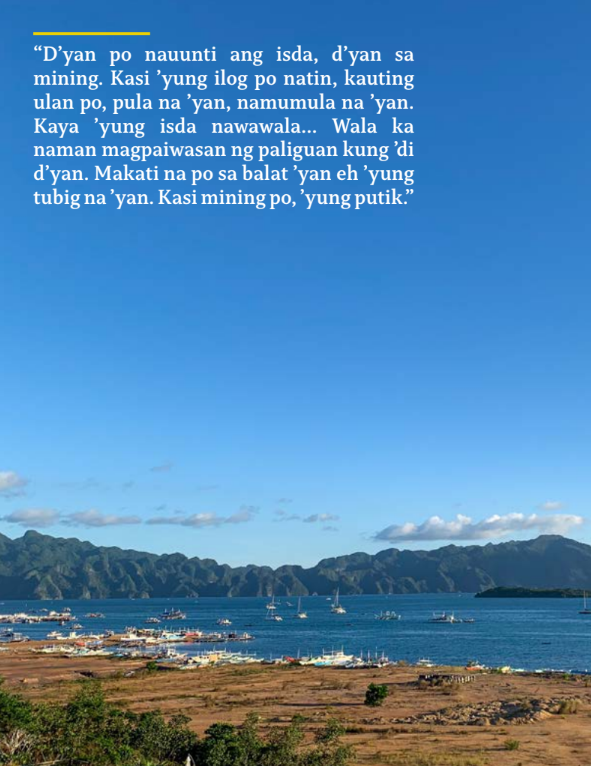
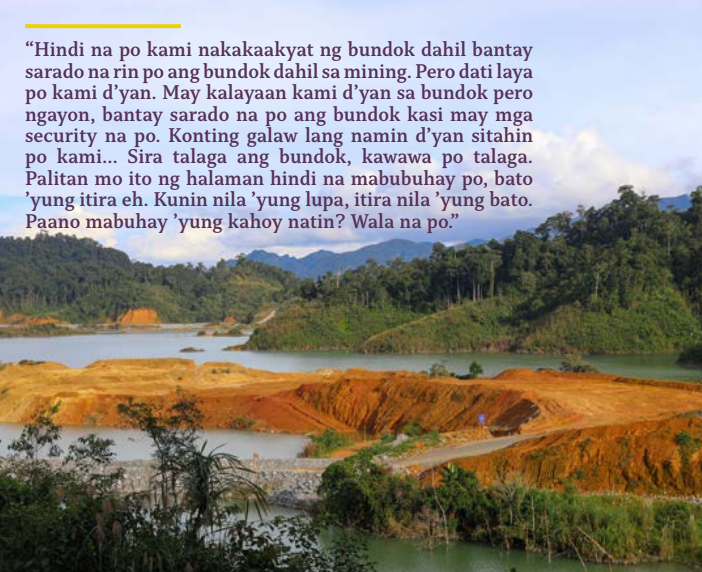
Projects in the name of so-called development have led to environmental destruction and human rights degradation. Partner communities in Zambales and Nueva Vizcaya have reported the effects of mining in their everyday lives, all of which are negative. In Zambales, an indigenous group leader stated that their livelihoods were affected and that the quality of water worsened since the mining company infiltrated their area. They struggle with medical implications of mining effects while also being prohibited from accessing their lands.
“D’yan po nauunti ang isda, d’yan sa mining. Kasi ’yung ilog po natin, kauting ulan po, pula na ’yan, namumula na ’yan. Kaya ’yung isda nawawala… Wala ka naman magpaiwasan ng paliguan kung ’di d’yan. Makati na po sa
balat ’yan eh ’yung tubig na ’yan. Kasi mining po, ’yung putik. [That’s where the fish are disappearing, over there near the mining site. Because our river, even with just a little rain, turns red, it gets murky. That’s why the fish are vanishing… But there’s no other place to bathe except there. The water makes the skin itchy. It’s because of the mining, the mud.]”
“Hindi na po kami nakakaakyat ng bundok dahil bantay sarado na rin po ang bundok dahil sa mining. Pero dati laya po kami d’yan. May kalayaan kami d’yan sa bundok pero ngayon, bantay sarado na po ang bundok kasi may mga security na po. Konting galaw lang namin d’yan sitahin po kami… Sira talaga ang bundok, kawawa po talaga. Palitan mo ito ng halaman hindi na mabubuhay po, bato ’yung itira eh. Kunin nila ’yung lupa, itira nila ’yung bato. Paano mabuhay ’yung kahoy natin? Wala na po. [We can no longer go up the mountain because it is now heavily guarded due to mining. Before, we had freedom there. We could move freely in the mountains, but now, it’s strictly guarded because there are security personnel. Even the slightest movement, and they question us… The mountain is really destroyed, it’s very heartbreaking. If you try to plant anything, it won’t grow anymore because they leave nothing but rocks. They take the soil and leave the stones behind. How can trees survive? They can’t anymore.]”
Further, where used to be green mountains rich with biodiversity now have been desecrated; in Nueva Vizcaya, a local indigenous tribe reported that the mining operation in their area dirtied their waters, contaminated their soils, and negatively affected their children’s health.
“Mula noong lumalim po ’yung butas, ’yun po nangyari po ’yung ganyan– ’yung kakulangan sa tubig doon samin… Ang nakikita po at pansin ng father ko ay ’yung tanim n’yang citrus, noong wala pa pong mining, madami po ’yung bunga pero sa ngayon po, medyo umonti na po…“Ang napansin ko po ay noong nagumpisa po mag-blasting dito sa opening, maalikabok kasi. May datos kami na nakuha sa health clinic na medyo talaga tumaas na ’yung mga bata na nagkakaroon ng ubo. [Ever since the hole got deeper, that’s when the water shortage in our area started… My father noticed that his citrus plants used to bear plenty of fruit before the mining began, but now, the yield has decreased… What I’ve observed is that when blasting started during the mine’s opening, it became very dusty. We even gathered data from the health clinic showing that cases of children with coughs have significantly increased.]”
As if struggling to reclaim their land and have their basic needs met were not enough, the indigenous members were subjected to human rights abuses.
“May dalawang pulis na pinipilit po na pinapaalis ako sa aking kinatayuan. Nang hindi nila ako po mapaalis tapos may pumunta na isang lalake tapos binagsak po ’yung shield ng dalawang pulis na babae sa paa ko ng tatlong beses, and then ’yun po ’yung pagkakaroon ng injure ng paa ko hanggang sa natanggal po ’yung daliri ng aking paa… Talaga pong nanlumo po kami lalong lalo na po at sa dami po ng nabanggit sa research na mga violations ay bakit po binigyan po ng ating ahensya ng gobyerno ng permit po at saka renewal. [Two police officers were forcing me to leave my spot. When they couldn’t remove me, a man came over and slammed the shields of the two female police officers onto my foot three times. That’s how I got injured, and eventually, my toe was severed… We were truly devastated, especially considering the many violations mentioned in the research, then why did our government agency still grant and renew their permit?]”
For profitable private gains, the price seems to be environmental rights and human dignity, with indigenous peoples disproportionately marginalized.
Institutionalization of Mendicancy “AYUDA POLITICS”
The Marcos Jr. administration continues to lead the poor by a leash. As the 2025 midterm elections draw near, access to social amelioration programs or ayuda is increasingly politicized, much to the detriment of its beneficiaries who rely on these programs for temporary relief. While the DSWD assures the public that its programs such as the Assistance to Individuals in Crisis Situation (AICS) and the Ayuda para sa Kapos ang Kita Program (AKAP) are safe from vote buying and patronage politics owing to its “stringent verification and validation process,” PhilRights’ partner families say otherwise:
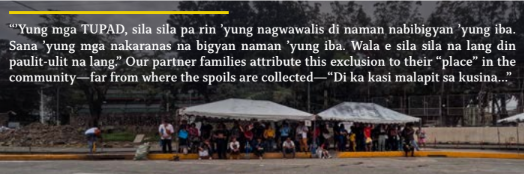
“’Yung mga TUPAD, sila sila pa rin ’yung nagwawalis di naman nabibigyan ’yung iba. Sana ’yung mga nakaranas na bigyan naman ’yung iba. Wala e sila sila na lang din paulit-ulit na lang. [The TUPAD workers, it’s always the same people doing the sweeping, while others don’t get a chance. I hope those who have already benefited can step aside so others can be given the opportunity. But no, it’s always the same people over and over again.]” Our partner families attribute this exclusion to their “place” in the community—far from where the spoils are collected—“Di ka kasi malapit sa kusina… [You’re not close to the kitchen…]”
The DSWD’s claims are further refuted by proof showing that these programs are indeed used as fronts for politicians’ pork barrel. AKAP is particularly notorious as members of the House of Representatives have been spotted in payouts where local politicians thank House Speaker Martin Romualdez on social media for the program. AICS is also a frontrunner in this regard as Senator Imee Marcos has been seen in local payouts, and press releases from Senators Robin Padilla and Bong Go have claimed that payouts come from them and are just coursed through the DSWD.
The swelling of funds earmarked for Ayuda in the 2025 national budget is also notable in this regard. In 2024, spending for cash assistance programs amounted to Php318.5 billion. In 2025, this will increase nearly twofold to Php591.8 billion. Most prominently the following programs will see increases in their budget: AICS will get an additional Php9.5 billion this year while Tulong Panghanapbuhay sa Ating Disadvantaged Workers Program (TUPAD) will see an additional Php5.8 billion despite lapses in the disbursement system of the cash-for-work program. Marcos Jr.’s government is only further institutionalizing the surface-level fixes that leaves many Filipinos clinging to high promises rather than being capacitated and empowered with the means to enjoy their rights.
Unequal playing field
In his third State of the Nation Address (SONA), Marcos Jr. reported that the poverty rate dropped to 15.5%. On the other hand, the Social Weather Stations (SWS) reports that December 2024 had the highest level of self-rated poverty wherein 17.4 million families saw themselves as poor. When asked in a focus group discussion (FGD), partner families collectively answered that their situations worsened in 2024. In juxtaposition, Forbes’ 2024 billionaires list included sixteen Filipino billionaires, whose wealth sum up to USD48.2 billion or Php2.7 trillion. Manuel Villar, Enrique Razon Jr., and Ramon Ang all have had increased wealth amidst the rising inflation within the country. The contrast of the poor’s sentiments to the rich’s grown wealth highlights the widening economic gap.
Higher living costs disproportionately disadvantage the poor. The government’s ayuda programs are merely band aid solutions to the deep trenches of cyclical poverty. In the FGDs with partner communities, it was vocalized that not all were able to acquire ayuda and some declared that the given aids were not enough. With the nearing midterm elections, ayuda programs have become more frequent. Partners in Rizal expressed preferring a stable, livable income rather than receiving ayuda, for the reason that financial aids only happen every now and then, which does not support their everyday needs. The State is accountable for upholding and protecting the rights of all its stakeholders, not just a privileged few. While private interests continue to thrive, the poor
endure the multifaceted consequences of economic inequality—limited employment opportunities, unlivable wages, restricted access to food and water, inadequate housing and environmental security, and inaccessible quality education and healthcare. This forces many to rely on unsustainable government support. When the cost of basic needs and services is set too high, it implies that a dignified life is reserved only for those who can afford it. Therefore, the officials elected in the upcoming elections must commit to their duty of empowering and realizing the rights of all people, most especially the marginalized.
Part 2. Imp-Unity: Muffling the Defenders
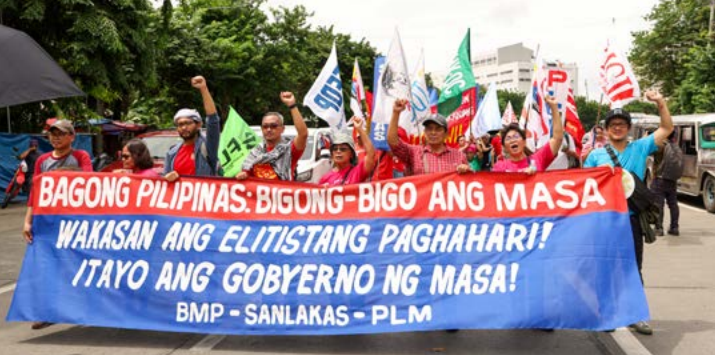
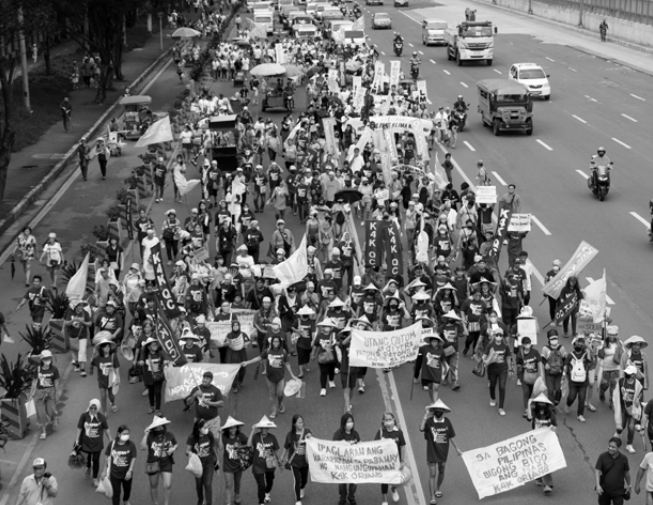
Accountability seems to be lost and unheard of to this day. The current regime actively engages in political maneuvers against its opponents, yet the civil and political issues that harm the very people it serves remain silenced, even as deafening shouts and clamor fill the streets. Protests, petitions, and calls for justice are dismissed as mere noise, with those in power turning a blind eye to the public’s demands. Instead of addressing the root causes of these grievances, the administration prioritizes self-preservation, using propaganda, diversionary issues and political distractions to shift the narrative. As a result, the cycle of impunity continues, leaving citizens frustrated yet forced to endure the very system that fails them.
HRDs under attack
On January 15, 2024, the procedural rules guiding all petitions and applications related to the Anti-Terrorism Act of 2020 took effect as finalized by the Supreme Court of the Philippines. These rules pertain to the detention without judicial warrants of arrest, surveillance orders, freeze orders, travel restrictions, designations, proscriptions, and other court rulings. Human rights organizations feared that the ruling would lead to the crippling of the rights of human rights defenders, including intensified surveillance and red-tagging. The Supreme Court declared in May 2024 that red-tagging is a threat to the right to life, liberty, and security of Human Rights Defenders (HRDs) after granting the writ of amparo to Siegfred Deduro against the military forces under the command of Major General Eric C. Vinoya of the 3rd Infantry Division of the Armed Forces of the Philippines (AFP). The military forces had tagged Deduro as part of the Communist Party of the Philippines-New People’s Army (CPP-NPA) in a presentation in Iloilo City on June 19, 2020, putting his life in danger and leaving him in constant fear.
However, red-tagging continued to be a practice among state agents. The Ateneo Human Rights Center (AHRC) recorded 456 red-tagging incidents from January to June 2024, mostly in Bicol Region, Ilocos Region, and Cordillera Administrative Region. Their findings showed that women were red-tagged three times more than men.
Task Force Detainees of the Philippines (TFDP) documented at least 15 confirmed cases of red-tagging from January to December 2024. The victims were involved in forming human rights alliances in their communities. In Manila, one woman HRD was harassed and surveilled by the local police for organizing a human rights formation with a previously red-tagged HRD. One victim was tagged as a member of the New People’s Army (NPA) by a barangay official for giving training on human rights in Rizal, demonstrating that the government conflates local dissent with armed insurgency.
Families of Victims of Involuntary Disappearance (FIND) received reports of at least 11 cases of enforced disappearance in 2024 that involved human rights defenders. These incidents occured in the provinces, including Zamboanga, Batangas, Bukidnon, Quezon, Isabela, Laguna, Albay, and Pangasinan. Among the cases assisted by FIND, only a few were resolved due to the lack of cooperation from the local police, a legacy of the Duterte administration that has persisted under the Marcos Jr. ‘s auspices. Testimonies from witnesses pointed to the elements of the AFP as the alleged perpetrators and highlighted that the victims had experienced surveillance and red-tagging prior to their disappearance.
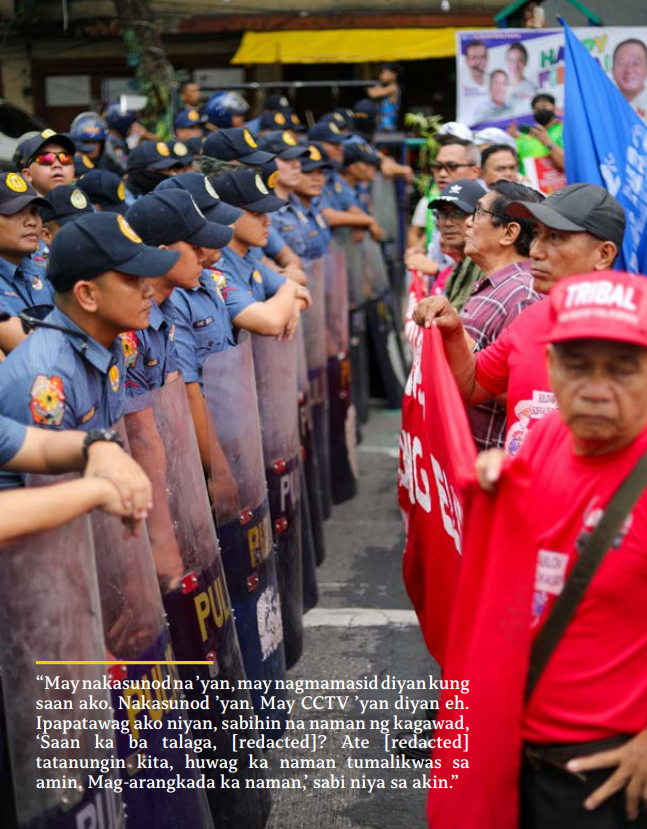
In our partner community in Bulacan, one woman HRD was abducted in 2023 for participating in campaigns against the attempt to raise the status of their city as a “Highly Urbanized City” (HUC) in the upcoming plebiscite. After she was released by the perpetrators and sought sanctuary from an allied politician, she experienced threats and surveillance this year, one in particular involved a barangay councilor.
“May nakasunod na ’yan, may nagmamasid diyan kung saan ako. Nakasunod ’yan. May CCTV ’yan diyan eh. Ipapatawag ako niyan, sabihin na naman ng kagawad, ‘Saan ka ba talaga, [redacted]? Ate [redacted] tatanungin kita, huwag ka naman tumalikwas sa amin. Mag-arangkada ka naman,’ sabi niya sa akin. [Someone is following me, watching where I go. They’re keeping track. There’s CCTV there. They’ll call me in, and the councilor will ask again, ‘Where have you really been, [redacted]?’ They’ll tell me, ‘Ate [redacted], I’m asking you—don’t turn your back on us. Cooperate,’ that’s what they said to me.]”
In the same community, one HRD also experienced similar forms of harassment due to their anti-HUC campaigns. “So naka-monitor po, may mga tao na po kung minsan diyan, may motor pa po na huminto sa harapan ko, nakatingin sa akin at nagpakita pa po ng baril. So alam ko na po ’yun ’yung mangyayari. [So I’m being monitored. Sometimes, there are people around, and once, a motorcycle stopped in front of me. The rider stared at me and even showed a gun. That’s when I knew what was about to happen.]”
He was asked if he voted “No” in the plebiscite, which he affirmed and defended.
“Sabi ko, ‘Opo, kuya. Karapatan ko po bilang isang tao, mamili kung anong gusto ko.’ Gusto ko po kasi mag-no kasi kawawa po ’yung mga mahirap kapag mag-yes ako. Bakit lahat ba ’yan, mabibigyan ba ng mga pagkain nila araw-araw? Mabibigyan ba ’yan ng trabaho? Wala. [I said, ‘Yes, kuya. It’s my right as a person to choose what I want.’ I wanted to say no because if I said yes, it would be unfair to the poor. Will everyone really be provided with food every day? Will they all be given jobs? No.]”
Baseless terrorism finance charges were filed against human rights defenders, Human Rights Watch (HRW), as part of the government’s effort to exit the “grey list” of the Financial Action Task Force (FATF). The Department of Justice (DOJ) accused the Cebu-based Community Empowerment and Resource Network (CERNET) in May 2024 of giving cash to the New People’s Army in 2012, causing the Anti-Money Laundering Council (AMLC) to freeze their bank accounts and forcing CERNET to cease operations. Police authorities accused three officials from the humanitarian group Kaduami in October 2024; Kaduami also expects their bank accounts to be frozen soon. The government, according to HRW, misuses the terrorism financing recommendations to harass civil society groups and activists.
The freedom to speak is stifled
During her visit to the Philippines from January 30 to February 2, 2024, UN Special Rapporteur on freedom of opinion and expression Irene Khan lauded what appeared to her as “positive signals” in the human rights situation as evidenced by the release of former Senator Leila de Lima, the reopening of peace talks with insurgent groups, and the acquittal of Maria Ressa from her tax fraud charges. However, she stressed that these “positive signals” are The freedom to speak is stifled not enough; there still needs to be “more fundamental and sustained reforms and a clear commitment to accountability.”
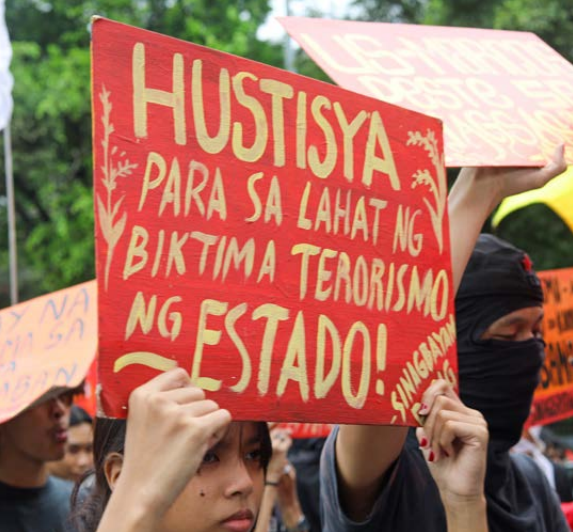
On media freedom, the damage caused by the previous Duterte administration continued to have palpable effects in 2024. UN Special Rapporteur Khan noted the “reduced media pluralism and decreased public trust in independent journalism as a result of viral disinformation and troll campaigns.” She recommended a series of legal reforms to align pertinent domestic laws with international standards and good practices, such as the review of the Anti-Terrorism Act of 2020 and the amendments on libel laws including the Cybercrime Prevention Act of 2012 which have been used to stifle dissent. She also recommended maximizing transparency and access to information to restore public trust.
Deep into the year 2024, these recommendations seemed to fall on deaf ears. The government and other actors continue to weaponize these said laws and engage in proliferating disinformation.
In view of the upcoming 2025 midterm elections, the country experienced a surge in Artificial Intelligence (AI)-assisted disinformation campaigns. Rappler’s factchecking of 458 articles revealed that from January to December 12, 2024, at least 12% was AI-generated or manipulated audiovisual outputs; the majority of which were health related, targeting news anchors, medical professionals, celebrities, politicians, sports personalities, and religious figures.
While there are bills aimed at addressing the proliferation of troll farms in Congress, there were numerous troll attacks on social media assets of human rights organizations. PhilRights experienced a peak of troll attacks on its Facebook page after it released its podcast episode on capitalism in December 2024. Troll farms, often harnessed conspicuously by government agents for years, have been used to derail healthy online discussions, malign human rights concepts, and discredit human rights organizations.
The government’s hold on media freedom remains evident. Broadcast media giant ABS-CBN has yet to be granted a franchise by the legislative bodies after its unfair and politicized revocation in 2020. Meanwhile, the Congress also revoked the franchise of Sonshine Media Network International (SMNI) for its blatant red-tagging of journalists including Atom Araullo and Maria Ressa and media outlets like Bulatlat, its peddling of fake news, and other violations of broadcasting standards. The Senate still needs to vote on the fate of SMNI’s franchise before it can be finalized by the president.
Journalists attacked and threatened
The New York-based Committee to Protect Journalists (CPJ) reported that no journalist was killed in the Philippines in 2024 for the first time in two decades, despite it being the deadliest year globally for journalists. However, from 1998 to 2024, the Philippines ranked second globally after Iran in terms of journalist killings with a total of 149 victims. Other forms of attacks and harassment also prevailed throughout the year and justice for the victims in the previous years has yet to be served.
The Center for Media Freedom and Responsibility (CMFR) and the National Union of Journalists of the Philippines (NUJP) recorded 135 incidents of attacks and threats against journalists from July 1, 2022 to April 30, 2024, which exceeded the recorded number of attacks and threats in the first 22 months of the Duterte administration.
The case of Percy Lapid is still ongoing despite the conviction of the gunman, Joel Escorial, of homicide. Joel Escorial pleaded guilty after asking the Branch 254 of the Las Piñas City Regional Trial Court to downgrade the charge from murder to homicide and was sentenced of up to 16 months of imprisonment. The co-accused former Bureau of Corrections (BuCor) official Ricardo Zulueta was said to have died of heart failure on March 15 in Bataan, raising questions about the possibility of foul play to hide the involvement of police authorities in the killing.
HR Violations continue in the drug war, albeit being off the radar
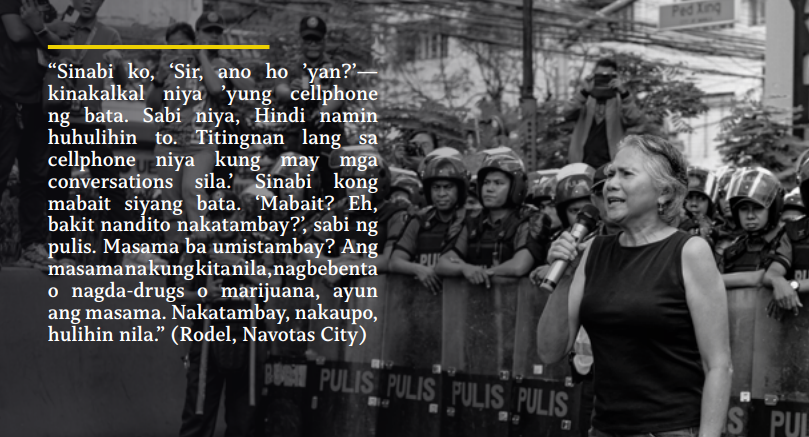
Data shows that the killings and other human rights violations in the context of the war on drugs continue to happen. As of November 23, University of the Philippines-based monitoring project Dahas recorded 848 media-reported drug-related killings during the whole Marcos Jr. administration. PhilRights documented 14 EJK victims during the same period, six of whom were killed in 2024.
In August 2024, the Philippine National Police (PNP) vowed to ‘recalibrate’ and ‘ensure a human rights-based approach’ in conducting its anti-drug campaign. This is one of the few instances that such a police agency gave a high regard to human rights as an approach after years of being an apparatus in vilifying it boldly in the public. This also signifies a slight admission that the previous approaches were unjust and against human rights standards. However, these pronouncements are mere lip service amidst the mounting international pressures. The police perpetrators continue to weaponize the guidelines that perpetuate the killing of drug targets in police operations.
TFDP said it was still difficult to conduct monitoring and documentation in communities because of the fear that the documenters would be harmed for doing their work. They observed that under Marcos Jr., the killings related to war on drugs were less prevalent, but they point to the change in the leadership. Marcos Jr. presents himself as compliant with human rights standards. But the analysis of documented cases remains: drug war-related violations continue despite the decreased intensity.
In Davao City, Sebastian Duterte announced a new drug war in their bailiwick in March 2024, and within the first 24 hours, five victims were already killed by local police authorities. TFDP in Mindanao noticed a further surge in the killings in the city.
Our partner communities continued to relay reports of violations from their local police. In Navotas City, there were reports of unlawful frisking and search by the local anti-illegal drug police unit against children who were staying and playing outside of their homes.
“Sinabi ko, ‘Sir, ano ho ’yan?’—kinakalkal niya ’yung cellphone ng bata. Sabi niya, Hindi namin huhulihin to. Titingnan lang sa cellphone niya kung may mga conversations sila.’ Sinabi kong mabait siyang bata. ‘Mabait? Eh, bakit nandito nakatambay?’, sabi ng pulis. Masama ba umistambay? Ang masama na kung kita nila, nagbebenta o nagda-drugs o marijuana, ayun ang masama. Nakatambay, nakaupo, hulihin nila. [I said, ‘Sir, what is that?’—he was rummaging through the child’s phone. He said, ‘We’re not going to arrest him. We’re just checking if he has any conversations.’ I told them that he’s a good kid. ‘Good? Then why is he loitering here?’ the police officer said. Is it really wrong to hang around? What’s wrong is if they catch someone selling or using drugs or marijuana—that would be wrong. But just sitting around, loitering, and they arrest them?]” (Rodel, Navotas City)
According to Children’s Legal Rights and Development Center (CLRDC), many cases of drug war-related violations against children, such as torture, unlawful arrest and detention, and extrajudicial killing under the current administration, were unreported by the mass media and were only shared in social media platforms. This reflects the normalization of State violence and systematic underreporting of the continuing drug war under the current administration. Some children they documented were arrested just for their mere presence in raids of their houses. Some of them were detained with adults and underwent judicial processes for adult offenders, violating the rights of the child stipulated in the Juvenile Justice and Welfare Act (JJWA). Families of victims are still frightened to file cases against the perpetrators due to the security threats from police authorities.
A frail justice system
Among the estimated 30,000 drug war-related killings during the Duterte administration and more than 800 killings during Marcos Jr. administration, only four known court convictions have been made against the direct perpetrators. The most recent one was in 2024 where four police officers were convicted for homicide for killing Luis Bonifacio and his 19-year old son, Gabriel Bonifacio in Caloocan City in 2016.
The Department of Justice (DOJ) asked the families of EJK victims and witnesses for their cooperation to criminally prosecute the perpetrators of HRVs. But as of this writing, the DOJ has yet to show that it is capable of criminal prosecution despite the number of cases it is preparing to file and being investigated. One partner family of PhilRights expressed their concerns about the intransparency in a process where their lives will be at stake, and for the sustainability of the whole prosecution process, even after the administration of Marcos Jr.
At the grassroots level, families of victims struggle with the challenges of filing cases. Police documents remain inaccessible to them, as police officers would interrogate them, or worse, threaten, intimidate, or harass them for doing so even in their own homes. Public lawyering was both inaccessible and unreliable, as per the narratives on public lawyers being reluctant to handle EJK-related cases. Ultimately, fear of reprisal from police perpetrators continues to be a burden for many families, especially that the judicial processes can take a long time. Many resorted to moving on or “ipagpasa-Diyos na lang [leave it to God]” when asked about accessing domestic remedies, evidence of entrenched impunity even in the most basic unit of the society.
No means no: Government defies International Mechanisms
The United Nations (UN) and the Philippine government recently concluded the UN Joint Programme on Human Rights in the Philippines (UNJP) on July 31, 2024 after the purportedly successful bringing of “transformative change through practical and rooted solutions to serve the noble causes of human dignity and social justice.”
Civil society organizations lament that the UNJP failed in maximizing their participation; that their engagement with the instrument was mostly consultative. The ending of the program also signified the exhaustion of its international sponsors in sustaining the changes claimed to have taken place in the Philippine government, given that the effects or outcomes of those changes (e.g., newly created institutions, changes in policies) have yet to come to fruition, especially in holding the direct and indirect perpetrators accountable. Sustaining diplomatic relations amidst the precarious geopolitics proves to have more weight than pressuring the Philippine government of its human rights obligations. And lastly, the Philippine government expressed that it would no longer cooperate with the UNJP should it be extended, showing that it is not committed to subjecting itself to international mechanisms.
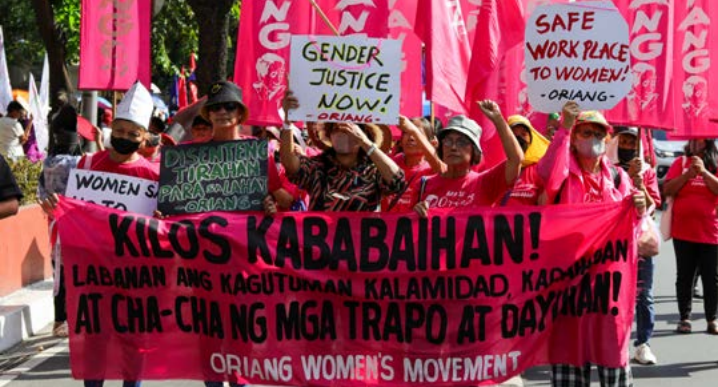
The International Criminal Court (ICC) remains to be one of the last beacons of hope for justice for the families of EJK victims. It continued to conduct its investigations after proving the lack of genuine intent to investigate and prosecute from the government in 2023 and its jurisdiction on cases that happened from 2011 until March 2019 when the withdrawal of the country from the Rome Statute took effect.
Marcos Jr. remained firm in his stance not to cooperate with the ICC. “Huwag niyong sasagutin, ’yun ang sagot natin. That we don’t recognize your jurisdiction, therefore, we will not assist in any way, shape or form, any of the investigations ICC is doing here in the Philippines.”, Marcos Jr. said in January 2024.


