

by Mateo P. Garcia
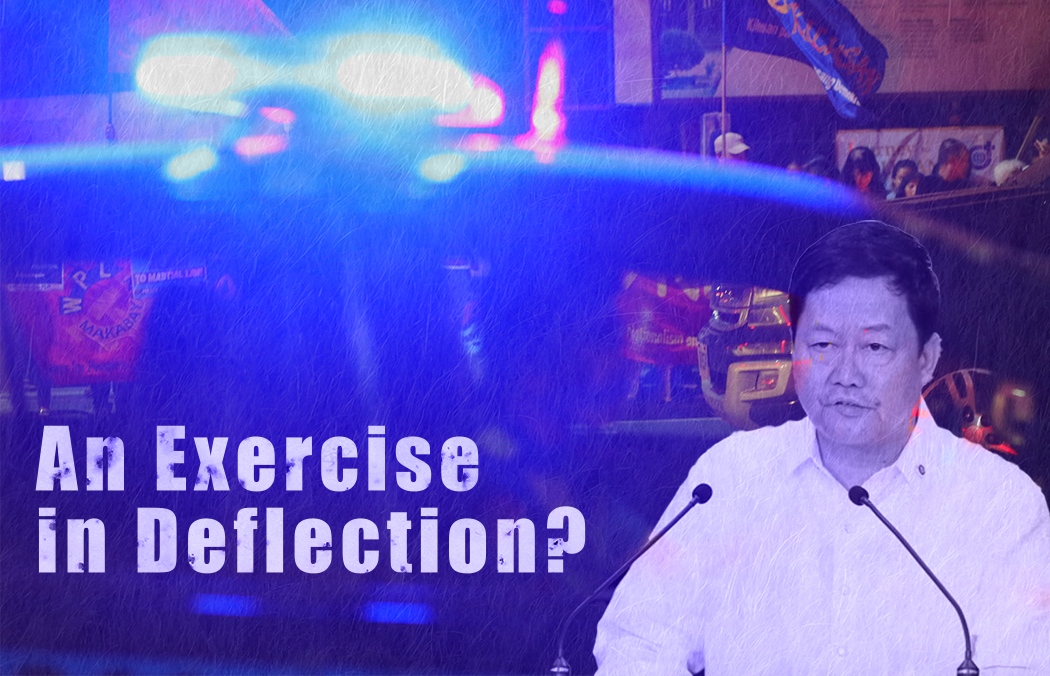
Department of Justice Secretary Menardo Guevarra made waves last week when he revealed the initial findings of the Justice department’s review panel on extrajudicial killings resulting from anti-illegal drug police operations.
Speaking via a video link at the 46th Regular Session of the United Nations Human Rights Council, Sec. Guevarra revealed that in many of these operations, police claimed that the victims resisted arrest or attempted to “fight back.” Guevarra also told the body that these nanlaban claims, a perennial justification for the killings, were not backed up with a full examination of the weapons supposedly wielded by victims, nor were there paraffin tests to prove that the victims did, in fact, fire their supposed weapons.
Guevarra went further to say that in more than half of their reviewed cases, law enforcement failed to follow protocols in coordinating with other agencies and in processing of the crime scenes.
On one hand, none of these findings sound new, especially if you ask human rights organizations and the families of the victims of extrajudicial killings. PhilRights’ own documentation reports in 2018 and 2019 in fact revealed similar information.
And yet Guevarra’s words are noteworthy if only because they were the most substantial acknowledgment of the human rights violations resulting from the so-called war on drugs. For years, the Duterte administration has been consistent in its narrative that, while belated in its desired results, the so-called war on drugs remains a core government policy and that criticisms of the bloody campaign are exaggerated propaganda.
Where Guevarra stops short is the acknowledgment that as a policy, the ongoing campaign against illegal drugs is fundamentally violative of human rights and has fostered a climate of impunity on a systematic scale; his Office can only say that the campaign’s implementation by the police is rife with procedural lapses and abuse. Instead, Guevarra made sure to mention that the campaign would continue.
Mixed Reactions
The Commission on Human Rights (CHR) called the DOJ’s conduct of the investigation and their findings a “step in the right direction.” Adding that, as the national human rights institution in the Philippines, the Commission “look[s] forward to be included” in the department’s review processes.
Amnesty International Philippines, for its part, called out the doublespeak in Guevarra’s address to the Human Rights Council. Section Director Butch Olano said that the secretary cannot assert the country’s legal and judicial systems are functioning when he just admitted the police’s lapses in protocol and conduct of investigations.
The International Coalition for Human Rights in the Philippines, meanwhile, maintained that Guevarra’s “reassuring diplomatic tone” during the HRC session “cannot hide the raw truth that so far there has been no accountability.” Adding that President Rodrigo Duterte himself “emboldens and issues policy statements for State authorities to commit human rights violations.”
Indeed, any hope for a respite from the authorities following Guevarra’s declarations was dashed when, on the same day, a resolution signed by 45 executives of the Cordillera region initiated a law enforcement-led Tokhang campaign against “left-leaning” personalities, explicitly adopting the mechanics of the so-called war on drugs and further legitimizing the government’s conflation of activism with insurgency.
Rights group LILAK (Purple Action for Indigenous Women’s Rights) expressed urgent concern: “We fear that the same acts of violence and impunity will be committed” as with Oplan Tokhang, adding that “[a]s it is, even without this new variant of Oplan Tokhang, indigenous peoples have been suffering deaths, arrests and torture from the government.”
Adding to the sense that the bloody campaign is not showing any signs of abating, a violent encounter between Quezon City police and agents of the Philippine Drug Enforcement Agency later that same day ended with four people dead and four more wounded.
What is the point, then?
If Guevarra’s high profile admonition of the conduct of the so-called war on drugs is not enough to pull the brakes on the campaign, what else could he be trying to achieve?
For one, this move reeks of a blatant attempt to misrepresent the Philippine government’s commitment to accountability. As the Philippine Alliance of Human Rights Advocates (PAHRA) emphasized, Guevarra’s report is an attempt to deflect accountability from the president and “misrepresent summary executions in the Philippines as mere procedural failures, while maintaining the illusion that domestic mechanisms are intact.”
This is especially crucial given last year’s damning report on the Philippine government’s handling of human rights by the High Commissioner for Human Rights of the United Nations. This was followed by an October resolution of the United Nations Human Rights Council that arranged for increased technical assistance and capacity-building for the Philippine government in the promotion and protection of human rights in the country.
There is also the declaration in December from the International Criminal Court’s prosecutor Fatou Bensouda that there is reasonable basis to believe that crimes against humanity of murder, torture, and the infliction of serious physical injury and mental harm may have occurred in the conduct of the so-called war on drugs.
The mounting international pressure therefore necessitated some concessions from the Philippine government, which might have included throwing the PNP under the bus through Guevarra’s statements. An obvious move, but possibly effective, in dimming the glare of unwanted international scrutiny.
As Phil Robertson, deputy Asia director at Human Rights Watch told the media last week, “No one should forget that the Philippines government excels at telling the international community what it wants to hear…only to forget the pledges and the promised follow-up as soon as their officials arrive back home.”
Indeed, Malacañang Palace, through presidential spokesperson Harry Roque, was quick to downplay Guevarra’s statements, denying that the secretary’s acknowledgment of police irregularities prove that human rights violations were committed during anti-illegal drug operations.
“What it does prove is that we are in the discharge of our state obligation to investigate and prosecute violation on the right to life,” Roque told reporters, adding that “[t]hat proves that our domestic legal system is working at hindi po dapat manghimasok ang ibang mga institusyon. [other institutions should not meddle]”
These are bold claims, easily belied by the fact that barely any prosecutions have led to successful claiming of justice for victims and their families.
The “War on Drugs” remains futile—and deadly
One thing that Guevarra’s statements did achieve, albeit unintentionally, is to underline the futility and senselessness of the government’s “drug war.” The Philippine Daily Inquirer’s editorial earlier this week, highlighted this: “For all the blood spilled, for all the killings that have grievously impacted thousands upon thousands of families and earned global censure for the Philippines, the drug problem remains.”
And yet the “war on drugs” train keeps trucking along. Earlier this week, the House of Representatives overwhelmingly voted for House Bill 7814, a measure amending the Comprehensive Dangerous Drugs Act (R.A. 9165) by adding 20 legal presumptions of guilt on drug suspects as well as reimposing the drug penalty.
Rose Trajano, secretary-general of the Philippine Alliance of Human Rights Advocates and convenor of the In Defense of Human Rights and Dignity movement said that such a move, “indicates that despite the horrific lapses in the implementation of the law as reported by the Justice Secretary before the UNHRC, the government is determined to further undermine human rights and the rule of law.”
These developments sitting side by side with Guevara’s report paint a picture of an administration that brazenly says one thing while doing the opposite.
Prof. Nymia Pimentel-Simbulan, executive director of PhilRights, noted that “there is little value in Sec. Guevarra’s report beyond paying lip service to the idea of accountability. More than anything, it proves the hypocrisy and lack of political will of this government in honoring its human rights obligations.”
Ultimately, Guevarra’s report is a drummed-up display devoid of substance. If the government were truly serious about its human rights obligations, it would commit to an immediate cessation of the so-called war on drugs, followed by the implementation of a rights-based drug policy and an offering of concrete guarantees on the attainment of justice for the victims and their families. Anything less simply would not do.


