

by Wyanet Alcibar
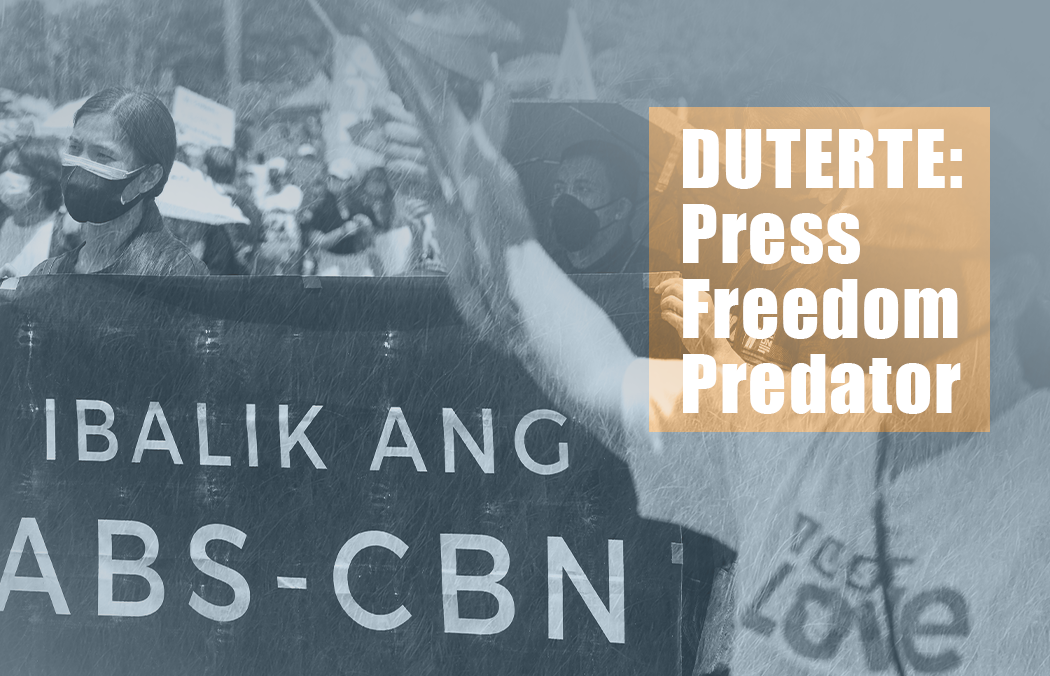
Rodrigo Duterte’s presidency is littered with examples of attacks on the free press, earning him the tag of press freedom predator from Reporters Without Borders in July. He joins 36 other world leaders in the ignoble list, among them North Korea’s Kim Jong-Un and Russia’s Vladimir Putin.
The group described Pres. Duterte’s “predatory method” as a “total war against independent media”, targeting the press through an arsenal of spurious charges, rescinding of broadcast licenses, getting allies to buy up media outlets and mobilizing an online troll army to harass journalists.
Malacañang called the report “baseless” and “bereft of merit.” This response, while expected, is itself inaccurate. Here are six examples why.
2016: Duterte justifies the killings of journalists before his inauguration
Even before he officially assumed office, Duterte was already hard at work justifying violence against members of the press.
“Just because you’re a journalist you are not exempted from assassination if you’re a son of a bitch,” he said on May 31, 2016. He explained that journalists who engage in corruption deserved to be killed.
Pres. Duterte also recalled the case of journalist Jun Pala’s murder in 2003 saying, “I do not want to diminish his memory but he is a rotten son of a bitch. He deserved it.” He argued that freedom of speech does not excuse or protect journalists from facing repercussions for defamation. This is an early indication that the president would not take kindly to any criticism from the press, whether valid or not.
Indeed, throughout the years, accusations of defamation and corruption would become a recurring theme in Duterte’s tirades against the press.
2017: Duterte accuses outlets of unfair reporting and of spreading fake news
“But someday— hindi ko tinatakot— but someday, ‘yung karma, dadating ‘yan,” Duterte warned in 2017, threatening the Philippine Daily Inquirer and the ABS-CBN television network.
He accused journalists from both outlets of publishing unfair reports at the behest of the outlets’ oligarch owners. Duterte particularly took offense at reports of “his alleged secret bank accounts…and speculations about his health.” Although unproven, such reports should not necessarily be considered unfair as these are issues of paramount public concern.
2018: Duterte personally bars Rappler reporter from entering the Palace
On January 11, 2018, the Securities and Exchange Commission (SEC) revoked Rappler’s license to operate. The SEC cited that the news agency received foreign funding, which violates the Constitution’s prohibition of foreign ownership in media institutions.
Supporting the SEC’s decision, Duterte later personally barred Rappler reporter Pia Ranada from entering Malacanang Palace and banned the agency from covering him. Duterte is quoted as saying, “I am now invoking executive action based on the SEC ruling. If it says they [Rappler] are legitimate, then you [Rappler] enter again.”
It was convenient for Malacañang to act under the pretense that its decision was not a matter of press freedom but of compliance with the Constitutional provisions on Filipino ownership of mass media.
2019: Duterte threatens to block the renewal of ABS-CBN’s franchise
The renewal of television network ABS-CBN’s franchise was subject to approval by Congress and President Duterte in 2020. The year before, Duterte renewed his repeated threats to block the renewal. The President alleged that the network failed to air his political ads for the 2016 elections despite receiving Php 2 million in payment, warning the network “You’re out. I will see to it that you’re out.”
Sure enough, the franchise application was denied in July 2020 by Congress where a coalition headed by Duterte holds a supermajority.
This debacle is not only a direct attack on ABS-CBN alone, but also a thinly veiled threat pointed at other media giants.
2020: Duterte supports the Anti-Terrorism Bill and signs it into law
The vagueness of the Anti-Terrorism Act allows the mere expression of dissent to be classified as terrorism. Existing safeguards within the Act are insufficient when such legislation is coupled with a culture of impunity in law enforcement.
Because the law is overbroad, it can make people unsure of whether their expressions of dissent may be classified as a crime, and ultimately make them opt to remain silent. It is in direct violation of Article III, Section 4 of the 1987 Philippine Constitution, which states, “No law shall be passed abridging the freedom of speech, of expression, or of the press, or the right of the people to peaceably to assemble and petition the Government for redress of grievances.”
The law has had a chilling effect not only broadly upon the people’s freedom of expression, but also upon the freedom of the press. Independent media and citizen journalists are made particularly vulnerable by the Anti-Terrorism Act.
2021: Journalists are red-tagged left and right
Duterte has not personally red-tagged a journalist, but law enforcement agencies and military personnel often do. This is evidence that the attack on press freedom has gone far beyond Duterte, and has become a systemic issue embedded in different levels of State authority. The culture of impunity encouraged by the President has emboldened the increased red-tagging of journalists. This can also be considered a direct result of the Anti-Terrorism Act.
In one incident in January, two Filipino journalists were included in a list of New People’s Army (NPA) members on the official Facebook page of the Armed Forces of the Philippines (AFP) Information Exchange. The AFP has since apologized and removed the post. Another incident just a month later saw Army Lt. Gen. Antonio Parlade Jr. accusing journalist Tetch Torres-Tupas of “aiding the terrorists by spreading lies.”
These are but six examples of how the current administration has created a hostile environment for a free press, further worsening the country’s long-held status as one of the most dangerous places in the world for journalists.


